YOLOv11-pose combines person detection, pose estimation, and entry-intent analysis
Accessible edge AI · JUN 2025
Computer Vision in Elevators
HYBLICON-II is an industrial computer-vision system developed with MP Ascensores. A lintel-mounted camera understands who is waiting, whether they intend to enter, and when mobility needs should influence elevator operation - all through a selective edge-inference pipeline.
YOLOv11-pose / PyTorch / OpenCV / Edge AI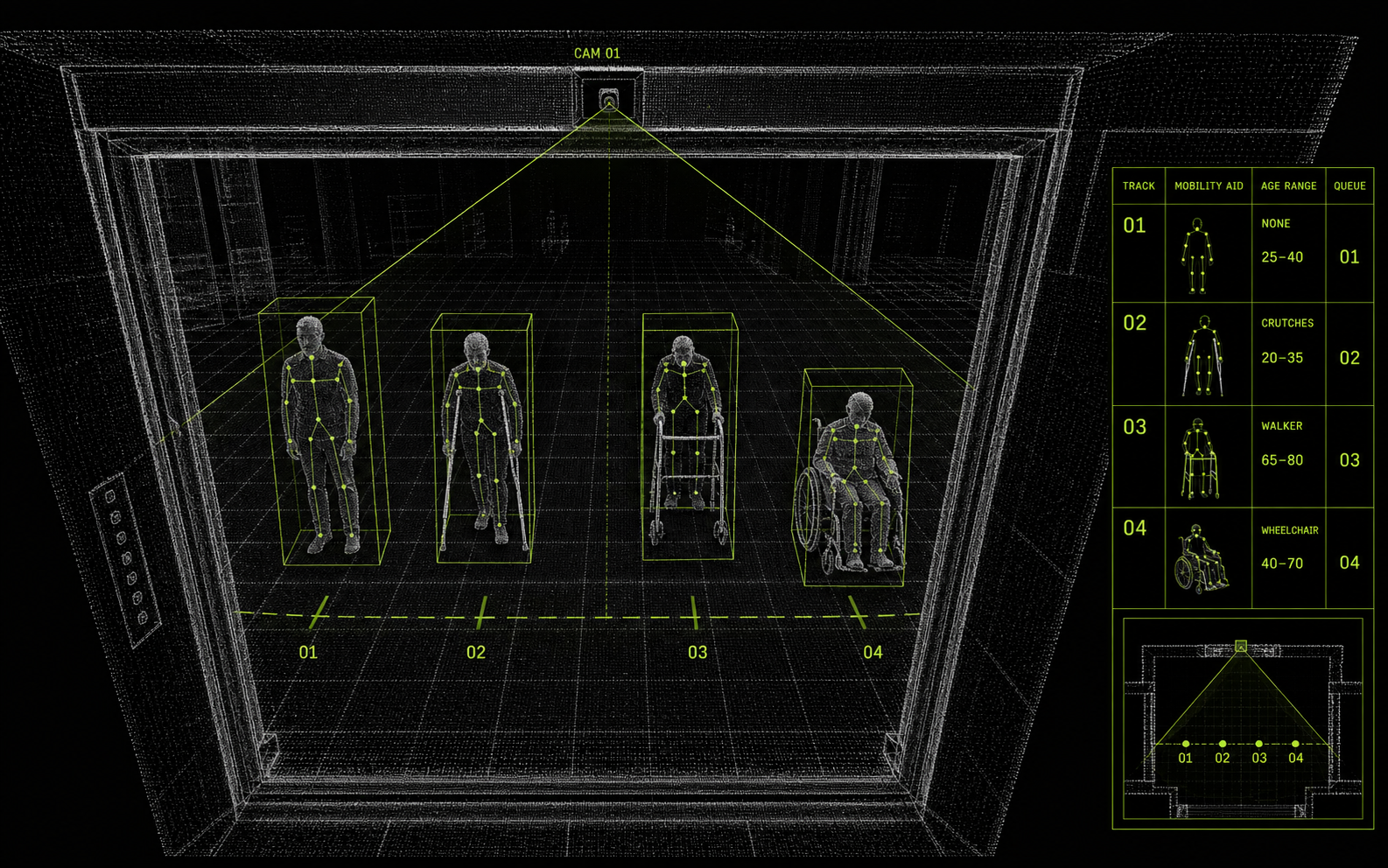 PROJECT VISUAL / VERIFIED
TL;DR / KEY SIGNALS
Mobility-aid model: 0.9325 precision, 0.9153 F1, and 0.8713 average IoU
Pure edge architecture designed around a Raspberry Pi Zero 2W
Industrial context
HYBLICON-II was developed over one year in collaboration with MP Ascensores as an R&D project in computer vision for elevator control and management.
A camera mounted in the lintel analyzes people waiting on the landing and sends real-time context to the control system. Beyond counting passengers, it estimates age range and gender, recognizes mobility aids, and determines whether each person actually intends to enter.
Four-block architecture
The vision module is divided into four cooperating blocks. YOLOv11-pose provides both bounding boxes and anatomical keypoints in a single pass, allowing the remaining modules to be activated intelligently.
- Person detection and pose estimation with YOLOv11-pose.
- Recognition of walkers, crutches, and wheelchairs.
- Age-range and gender classification from person crops.
- Entry-intent estimation from pose keypoints.
Intent-aware inference
Intent is estimated with lightweight rules over eye and waist keypoints. When both eyes and at least one waist keypoint fall in the middle or lower image bands, the person is interpreted as facing the door and intending to enter. A second rule handles partial head visibility in the lower band.
The demographic and mobility-aid classifiers only run after positive intent is confirmed. When nobody intends to enter, the system stays in a lightweight detection-only state, substantially reducing unnecessary computation.
Data and real-world evaluation
The models were trained with custom datasets: CCTV-style imagery for detection and cropped person samples for demographic classification. Collection, manual annotation, balancing, and validation were iterated throughout the project.
Real trials exposed the system to changing illumination, camera angles, simultaneous traffic, motion blur from vibration, occlusion, masks, grayscale input, and multiple resolutions from 200×200 to 1000×1000 pixels.
- Precision, recall, F1-score, IoU, and response time tracked across experiments.
- 400×400 selected as the strongest precision-to-latency compromise.
- Asynchronous capture and bounded frame queues used to maintain a continuous video stream.
Measured performance
On the mobility-aid evaluation set, the selected model achieved 0.9325 precision, 0.8986 recall, a 0.9153 F1-score, and 0.8713 average IoU across 585 images.
Measured mobility-aid inference averaged 0.031 seconds per image over a 30-image run and 0.045 seconds per image over a 60-image run. Grayscale testing showed only a minor variation, supporting lower-bandwidth processing scenarios.
Edge deployment
The deployment strategy keeps vision processing beside the camera rather than depending on an external server. The target architecture uses a Wi-Fi-enabled Raspberry Pi Zero 2W connected at the elevator lintel.
Remote management is performed through authenticated SSH, allowing model weights, logs, and services to be maintained without physical access. Logging is structured for future API integration with elevator controllers and building-management systems.
- Local inference supports privacy, latency, and availability goals.
- Selective model activation lowers the load on constrained hardware.
- Future work includes lighter architectures, pruning, quantization, few-shot adaptation, and broader mobility-aid classes.
FULL DOCUMENTATION
Open detailed PDFGo deeper into the complete project.
Open the original associated PDF for the full methodology, code, analysis, and project evidence.